Caring for parents in India from abroad: a practical guide for NRI families
Many of the families I speak to have a son or daughter in New Jersey, Dubai, London or Singapore, and parents in Kolkata, Ludhiana or Kochi. The love is the same as it always was. What has changed is the distance, and the time difference that comes with it.
A call at the end of your day lands at the start of theirs, or in the middle of their night. You hear “we’re fine”, and you have no way to check. This guide covers the practical things that make caring from abroad work: a trusted person nearby, the right paperwork, a written emergency plan, and visits home that count.
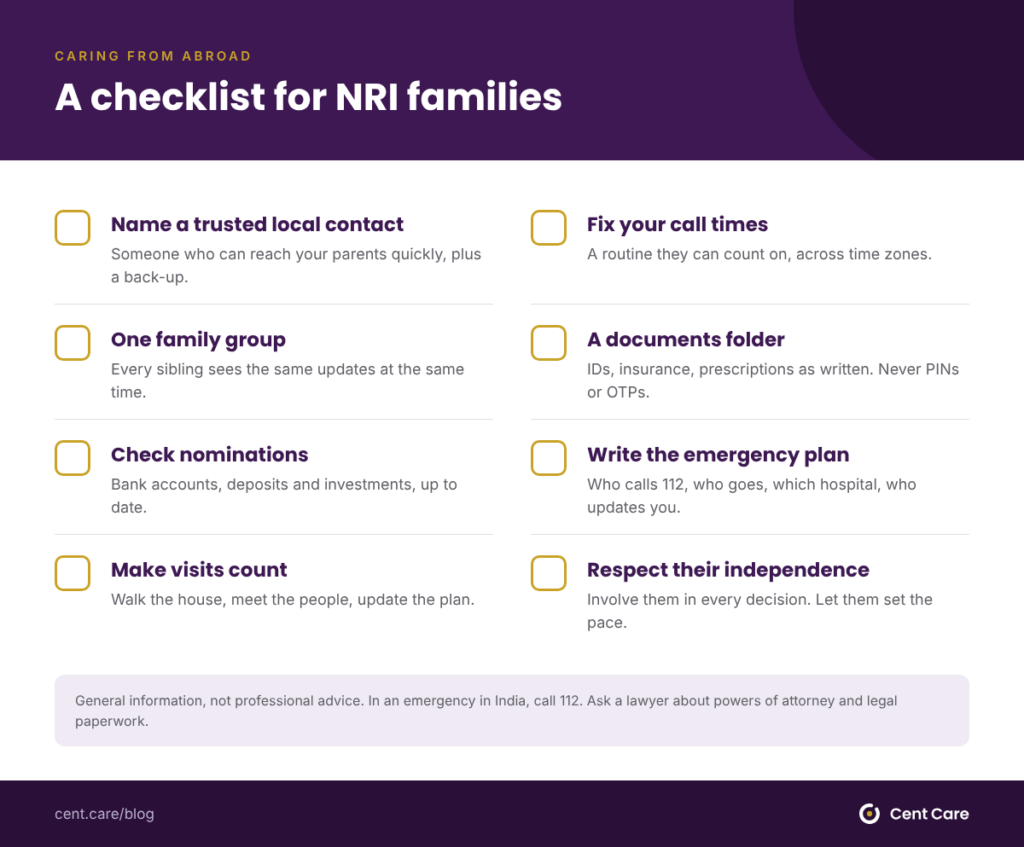
1. Name one trusted person nearby
Every family caring from abroad needs at least one person who can physically reach your parents quickly. It might be a relative, a neighbour, a close family friend or a professional care service. What matters is that they are named, willing and briefed.
- Agree what you are asking of them. A weekly visit? Being the first call in an emergency? Be specific, so goodwill does not quietly turn into an obligation.
- Have a back-up. People travel, fall ill or move away. A second name avoids depending on one person.
- Share the essentials with them: your parents’ doctor, preferred hospital, medicines list as prescribed, and where the spare keys are kept.
- Thank them properly. Informal help lasts longer when it is acknowledged.
2. Make the time difference work for you
- Fix your call times and keep them. A routine gives your parents something to look forward to, and makes a missed call meaningful.
- Keep one family group where updates are shared, so siblings in different countries see the same information at the same time.
- Save local numbers in your own phone: your parents’ neighbours, their doctor’s clinic, the nearest hospital and the local police station.
- Save 112 on every phone, theirs and yours. It is India’s single emergency number.
3. Sort the paperwork before you need it
From abroad, the most stressful moments are often paperwork moments: a hospital asks for an insurance card, a bank needs a signature, a pension needs its annual life certificate. A little preparation now saves a lot of panic later.
- A shared documents folder with copies of IDs, insurance policies, prescriptions as written, and bank and pension contacts. Never store PINs, passwords or OTPs in it.
- Nominations on bank accounts, deposits and investments, checked and up to date.
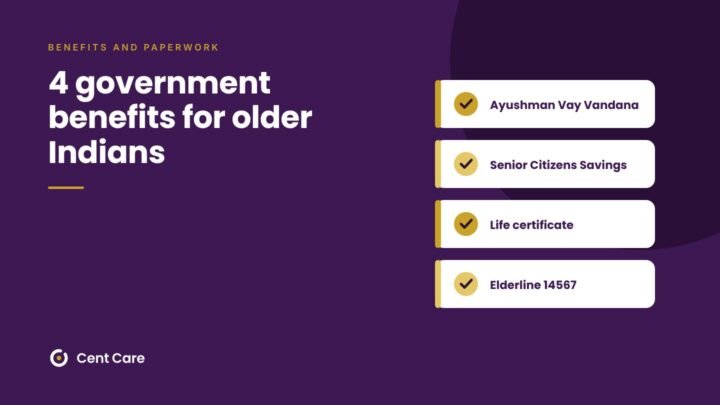
- The pension life certificate, if your parent draws a pension. It is usually due every November. See our guide to the pension life certificate.
- Authority to act. If you may need to act on your parents’ behalf in India, ask a lawyer whether a power of attorney or another arrangement suits your family, and how it must be signed and attested from the country you live in.
4. Write down the emergency plan
When something happens at 3 a.m. Indian time, nobody should be working out the plan on the spot. Agree it in advance, write it down and share it with everyone involved:
- Who your parents call first. In a medical emergency, that is 112, before anyone else.
- Who goes to the house, and who has a key.
- Which hospital, and which insurance or scheme card goes with them.
- Who updates the family abroad, and how often, until things settle.
Our checklist for families caring from another city has a one-page version you can print and keep by the phone.
5. Make visits home count
- Walk through the house with fresh eyes: lighting, loose rugs, bathroom safety. Our room-by-room home safety checklist helps.
- Meet the people in their lives: neighbours, the doctor’s clinic, any helper or care provider.
- Update the documents folder and the emergency plan while you are there.
- Notice what has changed since your last visit, and talk about it gently.
6. Respect their independence
Good support does not take over your parents’ lives. Involve them in every decision, start small and let them set the pace. Many parents worry about becoming a burden. Explaining that support gives you peace of mind, rather than taking something away from them, often makes it easier to accept.
Where Cent Care fits in
Most of the families we serve have a son or daughter in another city or another country, so we built Cent Care around that distance. Our trained, verified Care Managers, recruited through ex-servicemen networks, visit on a fixed schedule, log every visit and keep the family updated wherever they live. Plans can change as your parents’ needs change, with no lock-in. Our Care Managers are not doctors or nurses and do not give medical advice.
If you would like to meet us before deciding anything, book a free home visit or see our packages.
Important information. This article is general information and the personal view of the author, written for families. It is not medical, nursing, clinical, legal, financial, tax, investment or insurance advice, and it is not a substitute for advice from a qualified professional who knows your family’s circumstances. Always consult your parent’s doctor or another qualified healthcare professional about any health question, and a qualified adviser before making financial decisions. In an emergency, call 112 immediately. Government scheme rules, interest rates, eligibility criteria and deadlines change; always confirm the current position with the official website, bank or office concerned before acting. While we try to keep this information accurate and up to date, Cent Care Technologies Pvt. Ltd. makes no representations or warranties about its completeness, accuracy or suitability for your situation, and accepts no liability for any loss or harm arising from reliance on it. Statistics and figures are taken from the sources cited and may change. Links to external websites, apps and helplines are provided for convenience only; Cent Care does not operate, control or endorse them. Descriptions of Cent Care’s services are general; the terms of your service agreement apply.
This article is general information for families, not medical advice. For any health concern, speak to your parent's doctor. In an emergency, call 112.