India is ageing faster than its families are ready for
Please note: this is general, non-medical information for families, not professional advice. Read the full note at the end of this article.
Almost every family I speak to describes the same moment. A parent who managed everything, the bills, the house, the appointments, starts needing a little help. The children are in Pune, Bengaluru, Dubai or New Jersey. And a family that never had to plan for care suddenly has to work it out over the phone.This is not a story about a few families. It is one of the largest shifts India will live through in the next 25 years.
The numbers behind the shift
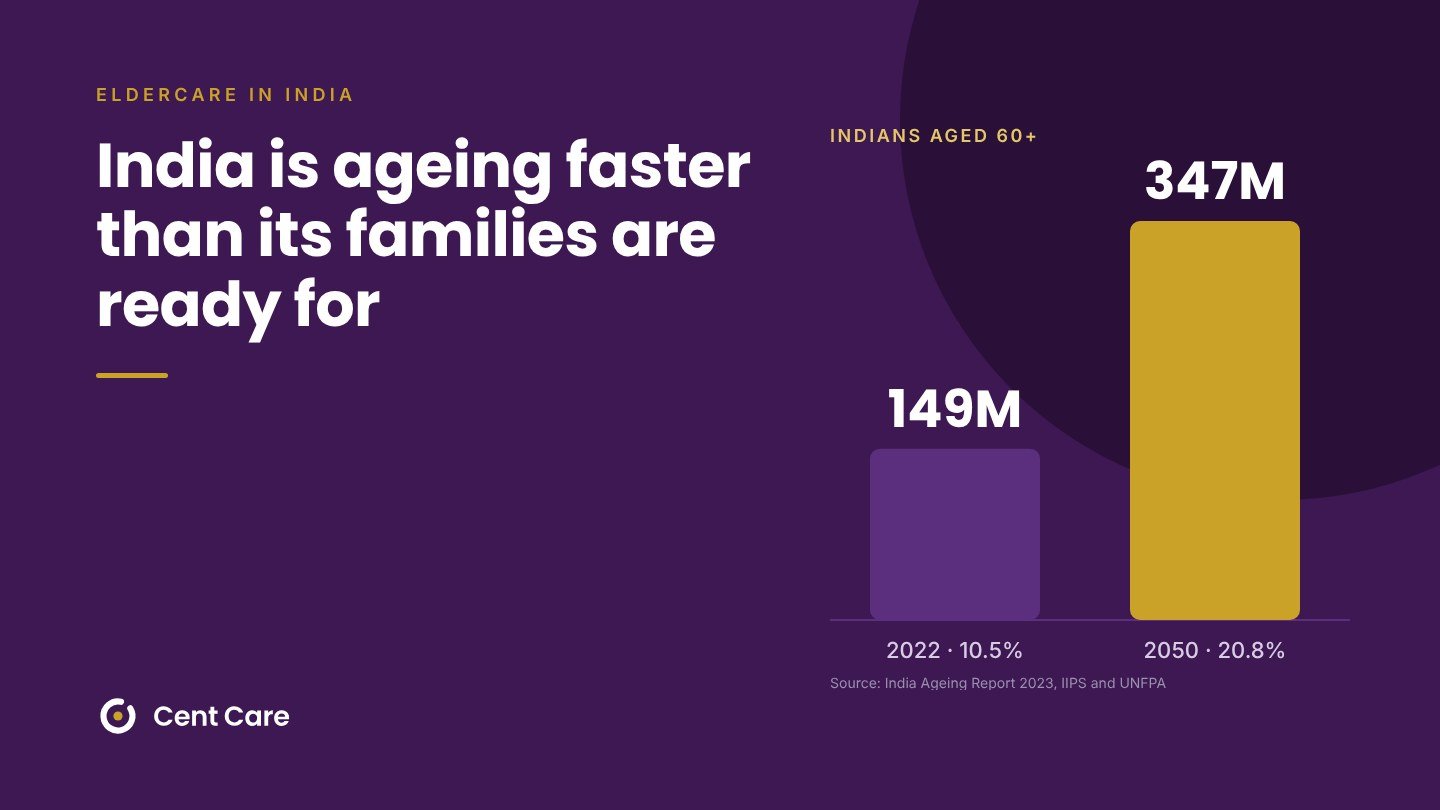
The India Ageing Report 2023, published by the International Institute for Population Sciences (IIPS) and UNFPA, puts India’s population aged 60 and above at 149 million in 2022, about 10.5% of the country. By 2050 it projects 347 million, or 20.8%: one in every five Indians. By the end of the century, the share is expected to cross 36%.
Older India is also increasingly female. The same report notes that at age 60, women in India can expect to live about 19 more years, against 18.3 for men. Many will spend those years widowed, and many in homes the children have moved away from.
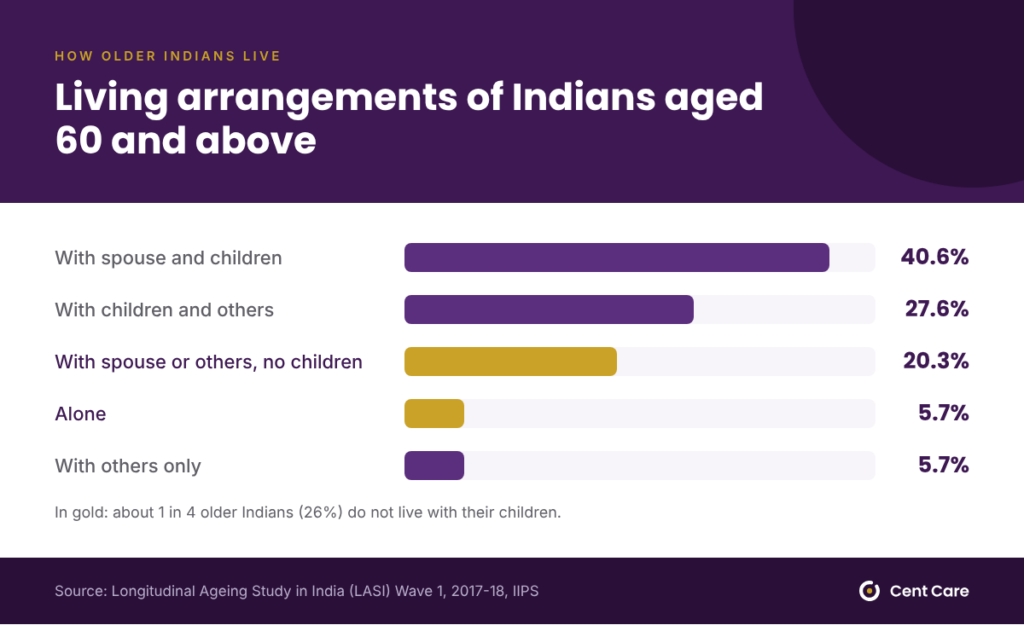
How older Indians live matters as much as how many there are. The Longitudinal Ageing Study in India (LASI, 2017-18) found that 5.7% of people aged 60 and above live alone, and a further 20.3% live with a spouse or others but not with their children. That is roughly one in four older Indians without a son or daughter under the same roof.
What changed inside the family
For generations, care for ageing parents in India was never “arranged”. It simply happened, inside a joint family, with several adults sharing the load. Three things have changed that.
- Children move for work. Careers take sons and daughters to metros and overseas, often a day’s travel away from their parents.
- Fewer hands at home. Smaller families and dual-income households mean there is rarely someone free during the day.
- Parents want to stay put. Most older people I meet want to age in their own home, in their own neighbourhood, close to the friends and routines they have built over decades.
None of this is a failure of love. It is a change in logistics. But the arrangement most families fall back on, a helpful neighbour, a part-time helper, a relative who lives nearby, was never designed to carry this much.
The gap between “someone to call” and real care
When I ask families what worries them most, the answer is rarely a specific illness. It is not knowing. Did the helper come today? Who would reach Ma first if she needed help at night? Would anyone notice if Baba stopped going for his evening walk?
Informal arrangements struggle with exactly these questions, because nothing is written down and nobody is accountable. Organised care, done well, closes that gap with a few unglamorous things:
- Verified people. Someone whose identity, background and training have been checked.
- A fixed schedule. Visits that happen on known days, not whenever someone is free.
- A record. A simple log of every visit that the family can see.
- An emergency plan. Agreed in advance: who responds, who calls whom, which hospital.
- The family in the loop. Updates to the children wherever they live, so decisions are made together.
None of these replaces a doctor, and none should try to. Health decisions belong with qualified medical professionals. What organised care adds is continuity: the same trusted presence, week after week, so that changes in routine are noticed and passed on to the family, who can then speak to the doctor.
What families can do this month
You don’t need a crisis to start planning. Three steps help almost every family:
- Have the conversation early. Ask your parents what they want: where they would like to live, what help they would accept and who they trust locally. Their answer should shape everything else.
- Write down the basics. Emergency contacts, key documents and the hospital they prefer, in one place everyone can find. Our practical checklist for families caring from another city walks through it.
- Know what to ask before you hire help. If you are considering a home care service, use our 10 questions to ask any provider before you sign anything.
Why we started Cent Care
We built Cent Care because this gap is too important to leave to chance. We wanted a service that brings discipline, accountability and warmth to caring for parents at home, and keeps children informed wherever they are. That is why our Care Managers are trained and verified, why every visit is logged, and why families see updates on their phone.
India’s ageing is not something to fear. It is a sign of longer lives. Our job, as families and as a society, is to make sure those longer lives are lived with dignity, at home, among people who care.
If you would like to talk through your family’s situation, book a free home visit or see how Cent Care works.
Important information. This article is general information and the personal view of the author, written for families. It is not medical, nursing, clinical, legal, financial or insurance advice, and it is not a substitute for advice from a qualified professional who knows your family’s circumstances. Always consult your parent’s doctor or another qualified healthcare professional about any health question, symptom or change, and before acting on anything you read online. In an emergency, call 112 immediately. While we try to keep this information accurate and up to date, Cent Care Technologies Pvt. Ltd. makes no representations or warranties about its completeness, accuracy or suitability for your situation, and accepts no liability for any loss or harm arising from reliance on it. Statistics are taken from the sources cited and may change. Links to external websites and helplines are provided for convenience only; Cent Care does not operate, control or endorse them. Descriptions of Cent Care’s services are general; the terms of your service agreement apply.
Sources: India Ageing Report 2023, IIPS and UNFPA (as reported by Down To Earth, September 2023); LASI Wave 1 India Fact Sheet, IIPS, 2017-18.
This article is general information for families, not medical advice. For any health concern, speak to your parent's doctor. In an emergency, call 112.